Monday, 10 August 2026

Scythe


Neal Shusterman © 2016

Just wow.

The novel’s cover announces that ‘Scythe’ is, ‘a true successor to The Hunger Games’ as if it needed a leg up. I disagree. It is a stand-alone, nail-biting and captivating ride into our near future; a truly insightful and alarming foray into unbridled human nature, the good and the oh so bad.

Imagine a world where AI has eradicated poverty, disease, death and aging, to name a few. Like me, you might automatically clock that the population would grow to exploding point, right? Herein lies the premise – there are a select group of trained people whose sole purpose in life is to keep the human population at a sustainable level. Enter the Scythes.

The hallmarks of a Scythe – or becoming a candidate to be trained as a Scythe – are the traits of humility, compassion and empathy. For this reason, individuals may respectfully fear the Scythe but will inherently trust in the killing selection process such that being ‘gleaned’ is for the greater good of humanity. But…

What happens when a Scythe develops a blood lust, feeding off the fear of victims and basking in his or her god-like status? Read the book and you’ll find out!

“Do you know what this is?” she asked.

“It’s a tweaker’” Rowan told her. He’d had the occasion several years ago to have his nanites tweaked when his teachers decided his moodiness had crossed the line into depression. That was five or six years ago. The tweaking was painless, and the effect subtle. He hadn’t noticed much of a change, but everyone agreed that he had begun to smile more.

“Arms out, legs spread,” said Scythe Rand…

The other Scythes then removed their cumbersome outer robes. Now down to their tunics and knickers, they took aggressive stances. There was a look of determination on each of their faces, and maybe a little bit of joyous anticipation. Rowan knew what was about to happen an instant before it began.

Scythe Chomsky, the largest of them, stepped forward and, without warning, swung his fist, connecting with Rowan’s cheek so hard, he spun around, lost his footing, and fell to the dusty floor.

Rowan felt the shock of the punch, the jagged bolt of pain, and waited for the telltale warmth of his nanites releasing pain-killing opiates into his bloodstream. But relief didn’t come. Instead the pain swelled.

It was horrible.

Overwhelming.

Rowan had never experienced such pain – he never knew such pain could even exist.

“What did you do?” he wailed. “What did you do to me?”

“We turned off your nanites,” Scythe Volta said calmly, “so you could experience what our ancestors once did.”

“There’s a very old expression,” Scythe Goddard told him. “ ‘To be painless is to be gainless.’ “ He gripped Rowan warmly on the shoulder. “And I wish you to gain much.”

Then he stood back, signaled the others to advance, and they began to beat Rowan to a pulp.

(pp. 221-2)


Wednesday, 25 March 2026

Desert Tracks


(c) 2025 by Marly Wells and Linda Wells

It was not too long ago that I wrote a blog which posed the question, can we ever read too much about the holocaust? (Of course not.) This post is posing the same question regarding First Australians, but the confronting truth is, there aint so much out there truth-telling for YAs. 

I applaud the courage of the authors of 'Desert Tracks' for unapologetically naming the beast and addressing the fallout from (and since) colonisation. If it looks like a duck, and quacks like a duck... to my mind, there is no stone left unturned (gulp) but the reader is surprisingly left with hope for the future. Education is the key. Guess that's why I still love my job.

The Wells' write with grace. The narrative is not bitter in spite of its clarity in outlining historical atrocities eked upon Aboriginal Australians. In a fantasy style, using time travel, the reader is given a firsthand glimpse of what life may have been like for Aboriginal Australians living in Central Australia during colonisation. There are also many reality checks for what life is like around Alice Springs today. The story has a sense of balance and fairness in the researched findings - anyone who is behaving in an inhumane or corrupt manner is called out. The language of the text is simple. An easy read of only 240 pp, it would speak to students from10 years old up.

Aunt Gem laughed. 'I don't know bout comin into schools. We didn't have such a good time at school Millie. It's hard for people of my generation to go into schools, even now. But it is getting better. They startin to tell the whole story, not just from the white man's point of view... What appened before, it's not over. Colonisation aint something the white fellas brought in a while ago, like one big, brutal party, and it's all over now. Where's it gone? Nah, it's right ere, every day. Every day our mob feel the consequences of that colonisation that just keeps on goin. Why are the jails full of our mob? The hospitals? Why our mob the poorest, most unemployed people? Why we die young, especially our blokes. We not useless, Mill. We good people. But when the white man came, e set up systems to support is way. We live ere for thousands of years my niece, lookin after this country, passin on our ways. Ow long them mob been here? Coupla minutes. An they already done so much damage, to us, to the land, to the other species. It's not over, Mill. Past isn't past. Past is ere, right now.' (pp.60-1)

Thursday, 3 July 2025

Gathering Blue by Lois Lowry (c) 2000


On a whim, I picked up a copy of the current Year 8 text by the same author. 'The Giver' is the first of four in this fantasy series and totally new to me. Delightful! As was the film. Although a simple story, it is one which stays with you as the layers reveal themselves, as do the interpretations of said. Consequently, it was a no-brainer to grab the second book, which I will write about now.
I guess I should start by saying that the story does stand alone. As far as I can see, there are no overt links to 'The Giver'. Good thinking, LL, as I will certainly dive into the third, now.
'Gathering Blue' is also a gentle read - simple narrative, likeable characters, humming (but not distressing) conflict. Sure, there is an untimely death at the start but thankfully the remaining crippled orphan is 'rescued', and so the story goes. The protagonist (orphan) Kira has weaving magic, that is to say, she supernaturally spins stories in coloured thread. Her gift is acknowledged by The Guardians who elect to care for her in a castle of sorts, so she can weave and repair the so-called the robe containing the world's history. While there, Kira meets two other 'gifted' orphans - a wood carver and a singing toddler. They, too, will take their places to ensure that history is not lost.
So, what is the reader to think? I suppose the biggest shadow is cast when we begin suspecting that the orphans' parents were likely murdered to secure said magical gifts. As this gnawing uncertainty grows, we start looking at everyone suspiciously.
I suggest you start with 'The Giver'. And I am going to launch myself into the final two books - just in time for the school holidays.
She saw Vandara lean down and pick up a rock the size of a tyke's fist. "We don't want you here," the woman said. "You don't belong in the village anymore. You're worthless with that leg. Your mother always protected you but she's gone now. You should go too. Why didn't you just stay in the Field?"
Kira saw that she was surrounded by hostile women who has come from their cotts and were watching Vandara for instructions and leadership. Several, she noticed, had rocks in their hands. If one rock were thrown, others would follow, she knew. They were all waiting for the first.
What would my mother have done? she thought frantically, and tried to call wisdom from the bit of her mother's spirit that lived on in her now. (pp.18-19)

Wednesday, 8 May 2024

The Great Gatsby - graphic novel adaptation


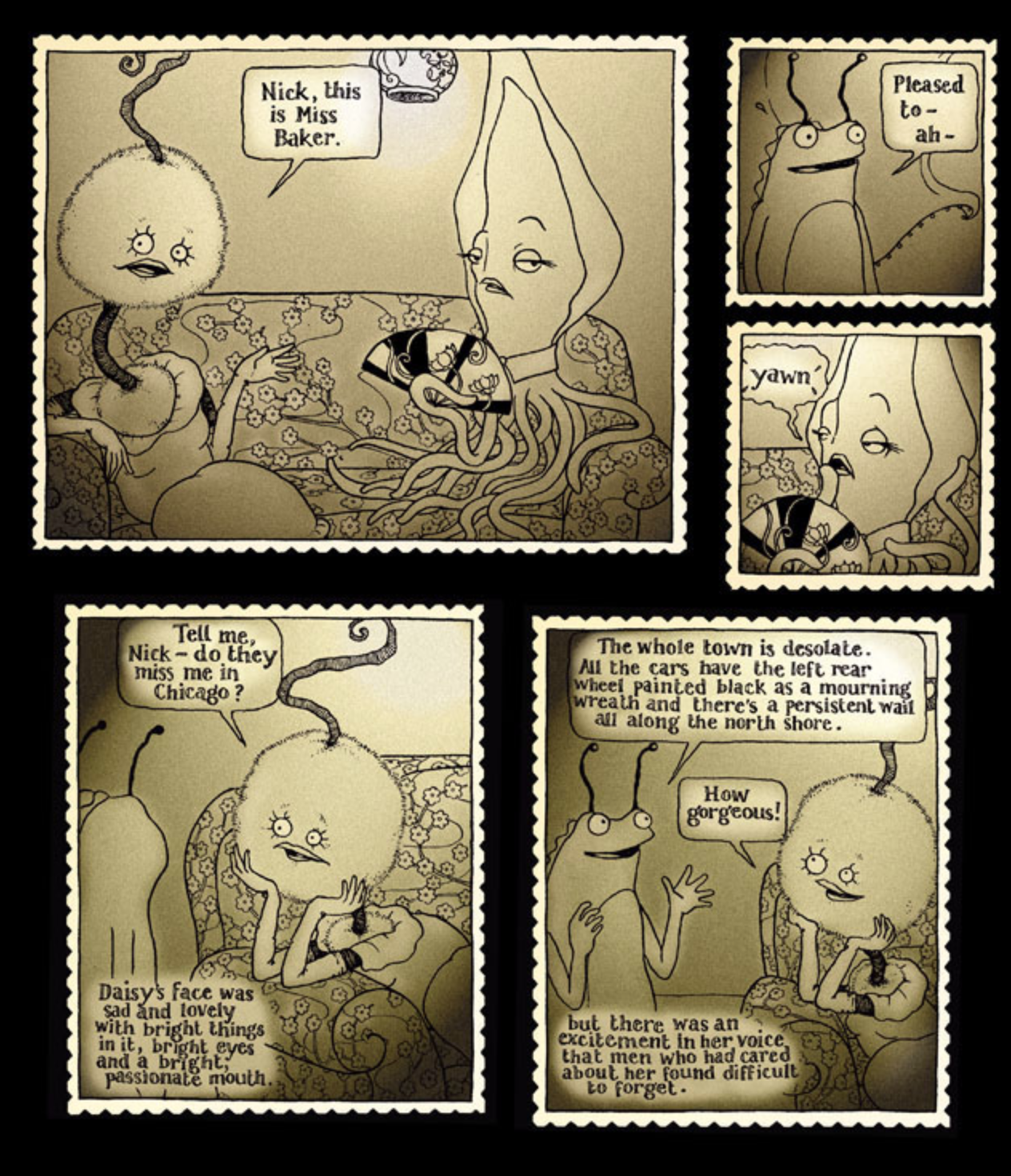
So, you can do justice to a timeless classic in graphic novel form. Who knew? Nicki Greenberg's six-year labour of love is palpable in the richness of the illustrations and the selection of text. Wow, I say.

It has been many years since I discovered Gatsby. A romantic at heart, I loved it. I am sharing this post in the hope that some of you less literature-lovin' folk will dip a toe in and see what the fuss has been about.

To my mind, by cartoonifying the characters (is that even a word?), the reader can absorb enough of the original text without feeling giddy.

Check out the arrogance and disdain captured in the expression and body language of Miss Baker. Brilliant! Greenberg has managed to do this for all the characters, every time. What a gift!

Do yourself a fat favour and read the book.

Miss ^__^

Monday, 4 December 2023

In the Secret Place

 by Gary Crew (c) 2023


It has been a long time since I have read an engaging story which I would class as ‘gentle’ in its tone. ‘In the Secret Place’ has all the hallmarks of a good story without any of the angst and desperation of the hard-hitting issues of today which are so prevalent in YA Fiction In that regard, I think students from Year 5 – Year 8 (10 – 13 year olds) would appreciate this novel.

The story is about Ben Gardner, likeable and smart (he’s good at chess) yet carrying a painful secret which is somehow tied to his mildly crippled foot. Of course the bullies (called The Six, or, The Stupid Six!)) smell his fear and often torment him about his disability. Ben finds solace in his new friendship with Sonya (she doesn’t judge him) and the fact he has found a secret place down by the beach – a cave, which was only discovered by him because of a ‘disappearing’ fox.

              Yes, the fox had gone but, as he groped, pressing his fingertips against the chilly rock, all of a sudden, he fell forward.

              No cliff.

No rock.

He pulled back ono the track, lowering his backside onto the cushioning mac, crumpled there. His hand went to his mouth. The thought dawned: ‘There’s a hole behind there. A hole no one can see. The fox’s den, I bet…

In the deeper dark behind the bush, and with his torch battery useless, it wasn’t easy to access this secret place. (pp.73-4)

Crew has ensured that there are many plotlines that are all deliciously tied together by the final pages. The protagonist is ‘everyboy’ (as opposed to everyman) whose ‘coming of age’ embraces concerns ranging from the need to find your people, to self-worth, to the maybe flourishes of a first crush, to navigating a broken family, to the classic avoidance of the ‘mean boys’, to making your own adventure, to finding your inner strength, all of which are gender neutral, making the story ideal for all readers.

If I have one criticism, it would be that the protagonist’s dad drinks. Beer. Every time he is mentioned (it seems) and his lady companion is also usually chugging down wine when she isn't riding her Harley. The couple cannot 'do life' without downing a cold one. Crew does not comment on this, and it is certainly not key to any part of the plot – I am just on a bit of a bandwagon personally in a bid to stop the cultural acceptance of drinking. That aside, a do give this book a hearty recommendation. It is no wonder that Crew is heralded as ‘award-winning’.


Sunday, 13 March 2022

The Happiest Man on Earth


By Eddie Jaku ©2020


The cover reads: A Holocaust survivor shares how he found gratitude, kindness and hope in the darkest of places. This memoir can be read in one sitting. Jaku shares his memories of the hell that was the Holocaust in small snapshots. A good idea, really, as one long discourse of the inhumanity and terror would be too hard to bear.

Do I hate that man? No, I do not hate anyone. He was just weak and probably as scared as I was. He let his fear overtake his morals. And I know that for every cruel person in the world, there is a kind one… (p.105)

Suffice to say, this man is riddled with positivity. He survived on hope, living one day at a time, using intuition and taking calculated risks. He talks about broken bones and bullet wounds in the same way as I would tell you what I put on my toast this morning. Jaku has supreme faith in humanity – he doesn’t dwell on aberrations such as Hitler and the Nazis. At over 100 years old, we can learn much wisdom from this man. Check out his Ted Talk, much of which is in the book.

Saturday, 12 March 2022

Funky Town


By Paul (PK) Kennedy ©2021


Given I don’t have a sporting bone in my body, I applaud PK for his beautiful memoir which allows people like me to finally understand what the ruckus is all about. ‘Funky Town’ gets to the core of Aussie Rules by imbibing an intensely personal and, at times, vulnerable insight into how it feels to live and breathe footy. Kennedy dreamt of playing for the big league from childhood. His story reveals the highs and very lows without a sniff of the usual clichés. Sure, I skimmed over the cast of famous names and clubs, but the attention to detail in the writing had me mesmerized despite my ignorance. The fight for sporting fitness, the pre-match butterflies, the need to adhere to ‘superstitious’ rituals, the worship of brilliant players, the pithy and inspirational words measured out by the coach, the injuries, the timely reprimands… Most engaging, the rich descriptions of what it feels like to play at one’s peak:

The ball was finally mine. I ran my hands over it, turning it around and around. I looked down at its taut laces and little rubber valve. The familiarity of touch felt like an antidote to my self-doubt… The next twenty minutes surpassed all my previous feats in football, modest as they were to that point. Under a grey sky, with a breeze at my back, I forgot about my opponent and chased the ball, like a dog after a frisbee. Luck ran my way and I started to take marks, receive handballs, and even shout directions to other Saints. Most importantly, I stopped overthinking. The flow of the game, which had seemed hectic and foreign to me before, was now as familiar as kicking drop punts at the lightpost outside our house at Emmanuel Drive. I felt fresh and new and dynamic… With every possession my confidence surged. Words of encouragement from teammates were extra fuel. At one point I snatched up a loose ball in the back pocket and took off. My opponent came close to catching me. I heard him straining with effort. The boundary line was close, but I wasn’t about to surrender to it. I veered away, back into space. There were teammates on the wing, but they seemed miles away. Now I heard voices from the crowd. Carlton supporters. ‘Get him.’ ‘How far!?’ I hoped the Blues player chasing me wasn’t quick enough. I sidestepped one last time, swerving back toward the boundary. Without time to straighten up again, I guided the ball with my left hand onto my left foot. It wasn’t my natural side, but it felt natural now. I lowered it on an angle, the way you do when you want to kick a torpedo. This was almost arrogant. It’s hard enough to kick a torpedo on the run with your preferred foot. Luck winked at me. The ball landed in the perfect spot – to the side of my laces – and the ball covered the distance to my target at head height. I soaked up the clapping from Saints supporters. (excerpt from Chapter 28 ‘Another Chance’)

Believe it or not, the memoir is only in part about PK’s love of football. There is another important thread woven through his memories which spotlights the chilling truth of living in the same community as a serial killer. If you’re like me, you have the iPad handy to investigate further. (I had left Victoria by the time these murders occurred, so this was news to me.) No spoilers here. You’ll have to read the book to find out what ensued.

Another important inclusion outlines PK’s shyness and perceived awkward behavior around girls, and the culture of binge drinking to overcome this. His honesty here will be a huge encouragement and support to many teenagers.

I guess my final word on this would be how moving PK’s ‘functional’ family was/is. In this fatherless generation (such as were both his parents) it is rewarding to read about a stable, loving and imperfect family. This aspect of the text is very uplifting.

I recommend this text for older youth. Or PG recommended if being read by younger teens. A brilliant ‘coming of age’ read.