Thursday, 4 July 2019

The Name of the Wind

Patrick Rothfuss (2007)


I’m not a huge fan of the fantasy genre but there are one or two classics that are right up there including the Narnia Chronicles and Lord of the Rings. So when I was invited to read this door stopper I was a bit hesitant. Did I really want to commit to several ‘fantasy hours’ with an unknown writer? The shining eyes of its recommender (cheers, Jay) pushed me over the line enough for me to sagely commit to at least the first 50 pages. This is what I say to my students, too. Give it 50 pages before giving up on it. Well, within the first 10 pages I was hooked! (The first 10pp of the story, that is - I almost didn’t get there on account of the fact that this particular book is a commemorative limited edition hardback with a long winded self-aggrandizing author’s note. That was vile. Do not, I repeat, DO NOT read that part of the book if you happen across this 2017 edition. Unless you want to look at your favorite Hollywood actor with no make-up, in track pants, on the loo.)

‘The Name of the Wind’ is a rollicking good tale! Hugely entertaining!! The protagonist is perfect for this genre. So named ‘Kvothe’ is highly likeable. He is off-the-charts smart but due to his age (15-ish) is naïve and vulnerable as he is making his own way in the world. Of course, he has magic powers, but these are largely unexplored and under-developed which can create mayhem on days.

The author has ensured that all the fantasy boxes are ticked without being tedious or predictable. Every ‘instalment’ has a cliff-hanger, page-turning ending, which can be a problem if you want to eat, sleep, shop or shower! Several times I found myself exclaiming aloud or even talking to the book. That’s right up there with idiots who yell answers at the TV when watching quiz shows. Don’t they know the contestants can’t hear them?

Another reason I loved this story is the sporadic use of mischief and straight-up humour. Life is too short to be miserable – anything that can bring a smile or evoke a LOL is worth the investment. Rothfuss puts his capable finger on the pulse of the human condition at every turn. He is, quite plainly, a solid writer of merit. I say, get on board! I am gagging to read the sequel which is right next to me on Jay’s kindle. Yee har!!

            I was a curious child: quick with questions and eager to learn. With acrobats and actors as my teachers, it is little wonder that I never grew to dread lessons as most children do.
                  The roads were safer in those days, but cautious folk would still travel with our troupe for safety’s sake. They supplemented my education. I learned an eclectic smattering of Commonwealth law from a travelling barrister too drunk or too pompous to realise he was lecturing an eight-year-old. I learned woodcraft from a huntsman named Laclith who travelled with us for nearly a whole season.
                  I learned the sordid inner workings of the royal court in Modeg from a… courtesan. As my father used to say: ‘Call a jack a jack. Call a spade a spade. But always call a whore a lady. Their lives are hard enough, and it never hurts to be polite’.
                  Hetera smelled vaguely of cinnamon, and at nine years old I found her fascinating without exactly knowing why. She taught me I should never do anything in private that I didn’t want talked about in public, and cautioned me to not talk in my sleep.
                  And then there was Abenthy, my first real teacher. He taught me more than all the others set end to end. If not for him, I would never have become the man I am today.
                  I ask that you not hold it against him. He meant well. (p.55)

Wednesday, 13 February 2019

Year of Wonders – Geraldine Brooks

Have you ever wondered what it would have been like to live in the Middle Ages during the time of the Black Death? I was introduced to this book over ten years ago when I taught it to my year 10s. I loved it so much that when I was in the UK a few months ago I made sure I visited the actual village – Eyam – where the story was set. Talk about 3D writing! What a privilege to see everything come to life as I walked the very paths mentioned in Brooks’ fine work.

Brooks outlines in the afterword how she stumbled across the village of Eyam whilst on assignment in London in 1990. I, too, was captivated by its history, namely, in how the minister of the time passionately implored the residents to ‘lock down’ the village in a bid to stop the ‘plague seeds’ spreading beyond and infecting the nearby locales.

Beloved, I hear you in your hearts, saying that we already have fear. We fear this disease and the death it brings. But you will not leave this fear behind you. It will travel with you wheresoever you fly. And on your way, it will gather to itself a host of greater fears. For if you sicken in a stranger’s house, they may turn you out, they may lock you up to die in dreadful solitude. You will thirst, and none shall quench you. You will cry out, and your cries will fade into empty air. For in that stranger’s house, all you will receive is blame… they will heap their hatred upon you, in the hour when your greatest need is love! (Rev. Mompellion pp.105-6)

This work of fiction is plausible. There are storylines which adhere closely to historical records. I can testify to viewing the actual ‘plague houses’, the church, and many inscribed tombs. As for the rest, Brooks envelops the reader in the likely superstition, the livelihoods, the class structures, the religion and the very language of the period. The detail is graphic; the relationship dynamics are timeless.

            I almost dropped the pitcher in my shock… George Viccars lay with his head pushed to the side by a lump the size of a newborn piglet, a great, shiny, yellow-purple knob of pulsing flesh. His face, half turned away from me because of the excrescence, was flushed scarlet, or rather, blotched, with shapes like rings of rose petals blooming under his skin. His blonde hair was a dark, wet mess upon his head, and his pillow was drenched with sweat. There was a sweet, pungent smell in the garret. A smell like rotting apples. (p.42)

Brooks is a brilliant writer. My attempts to capture her gift in weaving a story leave much to be desired! She always manages to capture the tension wrought in the human condition – to save others at the peril of losing your own life or not. And of course there’s the sexual tension: sometimes restrained; sometimes unbridled. Just enough. Never gratuitous.

Enjoy my Eyam pics. What a ride!
Entrance to Church, Eyam Village UK


The original 'plague houses' still standing.


Courtesy of the Eyam Museum - replicas of George Viccars (the tailor) and Anne Frith

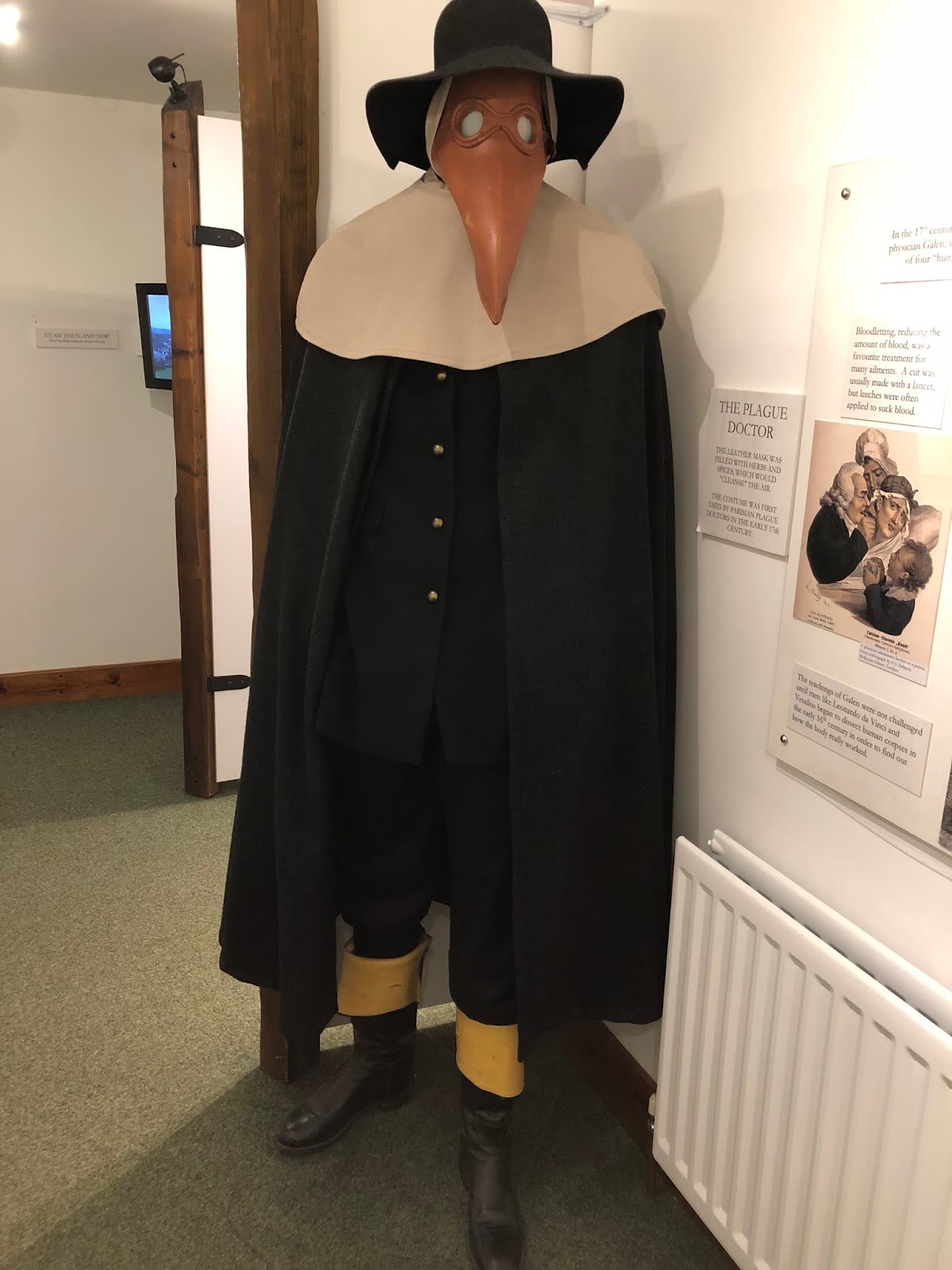
Replica of plague attire - the 'beak' is full of herbs

Replica of Rev. Mompesson (Mompellion) meeting with Rev. Stanley

Replica of the boundary stone. The holes were filled with vinegar before coins were added in exchange for supplies from beyond the village.

Plague victim. 

Catherine Mompession's tomb. 1666


I reckon this is the ancient celtic cross Anna Frith clung to in her time of despair.


Sunday, 10 December 2017

'The Life of a Teenage Body-Snatcher' by Doug MacLeod

I loved 'The Shiny Guys' so I had high expectations reading this older novel by MacLeod (2010). I thought the title was pretty outrageous and the book did not disappoint. The storyline was absolutely crazy - totes implausible and totes entertaining. It had irreverence and wit, a combination which may be lost on younger readers but surely kept the author engaged while he was constructing it.
Set in the 18oos in England, the author has had a laugh at language, the class systems, social mores (God forbid one was labelled a 'nancy boy') and socially accepted addictions, primarily the using of laudanum and its effects.
The premise is about a young man, Thomas Timewell, who decides to honour his late grandfather's wishes (donating his body to science) so he steals into the graveyard to inter the freshly buried body. It is here that he meets a professional body snatcher, Plenitude, who soon recruits Thomas due to his alacrity with corpse removal and his uncanny charm and good looks. From this point we meet 'demons', a naked gypsy, a 14 year old entrepreneur, an abusive teacher, a sexual pervert (his mother's friend), Thomas' drugged-out mother and his best friend who is accused of being a 'nancy-boy', amongst others. The settings focus around graveyards but let's not forget the tannery which contains a basement full of severed human heads!

The man continues to curse me, his head next to mine. Abruptly, I'm aware of what I must do to save my life. As my assaulter damns me, I thrust myself at the earth with all my strength and pull my torturer with me. In a split second I am on the ground. There is a bestial scream and my arms are released. Gasping, I turn around. The giant is staggering backwards. The sharp end of the stake has punctured him. He covers his bloody face with both hands and collapses. Next to the grave the stake still protrudes from the ground, its point wet. (pp. 66-7)
From time to time the anatomists don't accept the corpses. It can be for any number of reasons. Sometimes they won't take them because they remind them of their mothers. Funny, really. As if that would put you off. Anyway, if we can't sell a body to the anatomists, it's a wasted trip. So, occasionally, we sell them to pie-makers.' (p.142)
I lower my voice. 'I am a body snatcher. Really, I am. I do it for good reasons. I'm a gentleman body-snatcher, you see. Some people want their bodies left to science, but their families won't allow it. It happens almost daily. There is a new interest in anatomy and people want to advance it by leaving their bodies to be dissected. It's in their wills.' (p.196)

The book is labelled as a comedy, and rightly so. If you need a diversion from real life, this novel should be on your go-to list. Uncomplicated. Black. Cheeky. Fun.

Tuesday, 21 November 2017

Becoming Kirrali Lewis by Jane Harrison

First published in 2015, this novel caught my eye -again- due to the "State Library of Queensland Winner" medallion on the front cover. Then the blurb revealed it to be a story set in the 1980s (a decade close to my heart, including my uni years!) with flashbacks to the 60s; a story about an aboriginal girl adopted into a white family.
If any student were ever to earnestly enquire about Australian history, I think the best option would be to hand them a copy of this novel and follow up with a discussion afterwards. Harrison is thorough in her addressing of Aboriginal issues without being cliché - I appreciate that would be a hard thing for a writer to do, especially with such a contentious topic.
The writing is simple (think Sally Morgan's 'My Place') but interesting. At times I had to take a little break from reading as it was highly emotional in places. That might be due to the fact that I am a parent. I'd be interested to see if teenage readers would be as moved as I was at certain points.
Without giving too much away, here's an excerpt from when the protagonist was assaulted by a few racists thugs after she leaves the local pub:
   Kirk and I bolted. My clunky heels skidded on the uneven bluestone surface of the alley and within a few strides they had overtaken and surrounded us. I was flooded with fear.
   It happened quickly. I saw the flash of a fist and heard a crack like dry thunder. I realised Thug One must have broken Kirk's nose. He staggered back into the paling fence which shuddered along its length. Thug Two flung his arm around my neck in a headlock and I bit him as hard as I could. He leapt back, yelping in pain. I took a wild swing with my shoe at Thug Three's genitalia but missed. He lashed out with a backhanded punch and I went down, my knees hitting the pavers. Someone held me, someone stomped on my head. The pain was excruciating. Somewhere, Kirk was moaning.
   Worse than the pain was hearing guys my age, guys I might have gone to school with, or been neighbours with - ordinary guys- use those words. They called us niggers. No-hopers. Bludgers. Boongs. Filthy abos. And after each curse came their disgusting laughter... (pp.57-8)

Sunday, 5 November 2017

One Would Think the Deep by Claire Zorn

I always tell my students, look for the books with the pretty 'medals' adorning the cover. Well, this baby had no less than three! Zorn has (again) composed an engaging, relevant and punchy novel for older (youth) readers. I think boys would enjoy this one as it has stacks of surfing references, and the girls would enjoy the 'young love' additions. Basically, any teen who knows what it is like to be misunderstood, and who wants desperately to fit in, would attain great satisfaction from reading this.
I think Zorn creates vivid images in few words, so this novel would be brilliant as a class text.

The protagonist, Sam, leaves home after his mum dies unexpectedly. He is 'adopted' by an aunt who only just tolerates him being a part of her family. The reader is keenly aware that Sam is grieving and struggling to adapt to his new environment away from all his former support networks. The good news is, he re-kindles his close friendship with his surfer cousin 'Minty' and soon enjoys and adopts surfer habits; the bad news is Minty's brother Shane hates his guts. This is around the time we learn that Sam has severe anger management issues, so there's a bit of biff from time to time.

I don't want to give anything away, but there's a hot chick called Gretchen who certainly brings out a whole other side to Sam. Say no more!

I'll leave you with a surfing excerpt. Loved this book.

The ocean opened up in front of Sam. Waves bigger than he had ever seen, like cliff faces, sucking water off the rocks and rearing up before rolling back in again. The sound was like a hurricane or a bushfire, a merciless roar, the water devouring everything in its path. The sky seemed to become water, the horizon line gone altogether. Blinking the rain out of his eyes, Sam scanned the dark rolling water. He could just make out two figures. He peered over the edge to see Minty jumping off the rocks and into the churning black water... The three of them watched as Minty manoeuvred the board onto the crest of a wave. Sam held his breath and watched in disbelief as Minty got to his feet. One of the guys gave a low whistle. Minty, a tiny speck compared to the colossus of water, drifted down the face of the wave with his trade-mark casual stance, crouched low shoulder into the water, the fingertips of his right hand trailing along behind him, skimming the wall, like a kid playing with a fountain...  (p.79-80)


Wednesday, 11 October 2017

'Sparrow' by Scot Gardner

Fresh off the press, this little beauty is a thrilling story about a mute teenage boy who has been given the nick name 'Sparrow' due to his street habit of  flitting around and eating leftovers off others' plates. Set in Darwin, including the NT wilderness, the reader is confronted with the paradox of its stark natural beauty juxtaposed against the day-to-day perils of surviving in the steamy outback. As a resident of NT for the past 9 years, and a passionate fisherwoman, I can vouch for the accuracy of Gardner's research into Top End life.
The Waterfront: ... a few joggers and dog-walkers set ibis to flight along the lagoon path. The barista carried a stack of aluminium chairs... The boy followed him into a roofed dining shelter adjoining an Irish-themed pub. Most of his daylight hours were spent... splashing in the lagoon with kids from the hotels around the wharf.(17, 21, 55)
The Mangroves: ... He'd climbed as high as he could and the tide had continued to rise until it licked at the hem of his shorts. From his vantage he could see crocodiles in the water, hear their steam-venting sighs, grunts and bubbles... the gulf islands were laid out like sculptures on an infinite cerulean canvas. He saw the wide mouth of the river he'd swum in on and the verdant mangroves that straddled the brown water snaking inland... (24, 39)
Mindil Market: Tourists visited the market in their hundreds... people were buying all manner of things: T-shirts, jewellery made from shells and stones, paintings on canvas and old saw blades, crystals, paper kites...loud drumming and didjeridu music started down near the toilets... (41-3)
Fishing!!! The bait had been taken. He doubled the knot on the handle, re-baited, cast and held the stick with two white-knuckled fists. There were a few tantalising nibbles before a fish hooked itself. It pulled and zagged through the waves as Sparrow ran up the beach towing the flipping silver creature onto the pale sand... the fish was longer than his forearm and covered in silver scales, each one the size of his thumbnail. (112)
The climate: The sun bit at his neck and he wore his T-shirt as a scarf until his shoulders were red... Sparrow sprinted over hot sand... The skin on his nose and cheeks felt tight. (47, 81)

In no way have I covered the nail-biting, page-turning plot. I may already be giving too much away. Just to say, the story is compelling and rich with 'Wintonian' Australian details. The social commentary is timely (street kids, family violence, drug abuse) and the relationships plausible and compelling. Gardner has, again, nailed it.