Wednesday, 25 March 2026

Desert Tracks


(c) 2025 by Marly Wells and Linda Wells

It was not too long ago that I wrote a blog which posed the question, can we ever read too much about the holocaust? (Of course not.) This post is posing the same question regarding First Australians, but the confronting truth is, there aint so much out there truth-telling for YAs. 

I applaud the courage of the authors of 'Desert Tracks' for unapologetically naming the beast and addressing the fallout from (and since) colonisation. If it looks like a duck, and quacks like a duck... to my mind, there is no stone left unturned (gulp) but the reader is surprisingly left with hope for the future. Education is the key. Guess that's why I still love my job.

The Wells' write with grace. The narrative is not bitter in spite of its clarity in outlining historical atrocities eked upon Aboriginal Australians. In a fantasy style, using time travel, the reader is given a firsthand glimpse of what life may have been like for Aboriginal Australians living in Central Australia during colonisation. There are also many reality checks for what life is like around Alice Springs today. The story has a sense of balance and fairness in the researched findings - anyone who is behaving in an inhumane or corrupt manner is called out. The language of the text is simple. An easy read of only 240 pp, it would speak to students from10 years old up.

Aunt Gem laughed. 'I don't know bout comin into schools. We didn't have such a good time at school Millie. It's hard for people of my generation to go into schools, even now. But it is getting better. They startin to tell the whole story, not just from the white man's point of view... What appened before, it's not over. Colonisation aint something the white fellas brought in a while ago, like one big, brutal party, and it's all over now. Where's it gone? Nah, it's right ere, every day. Every day our mob feel the consequences of that colonisation that just keeps on goin. Why are the jails full of our mob? The hospitals? Why our mob the poorest, most unemployed people? Why we die young, especially our blokes. We not useless, Mill. We good people. But when the white man came, e set up systems to support is way. We live ere for thousands of years my niece, lookin after this country, passin on our ways. Ow long them mob been here? Coupla minutes. An they already done so much damage, to us, to the land, to the other species. It's not over, Mill. Past isn't past. Past is ere, right now.' (pp.60-1)

Thursday, 3 July 2025

Gathering Blue by Lois Lowry (c) 2000


On a whim, I picked up a copy of the current Year 8 text by the same author. 'The Giver' is the first of four in this fantasy series and totally new to me. Delightful! As was the film. Although a simple story, it is one which stays with you as the layers reveal themselves, as do the interpretations of said. Consequently, it was a no-brainer to grab the second book, which I will write about now.
I guess I should start by saying that the story does stand alone. As far as I can see, there are no overt links to 'The Giver'. Good thinking, LL, as I will certainly dive into the third, now.
'Gathering Blue' is also a gentle read - simple narrative, likeable characters, humming (but not distressing) conflict. Sure, there is an untimely death at the start but thankfully the remaining crippled orphan is 'rescued', and so the story goes. The protagonist (orphan) Kira has weaving magic, that is to say, she supernaturally spins stories in coloured thread. Her gift is acknowledged by The Guardians who elect to care for her in a castle of sorts, so she can weave and repair the so-called the robe containing the world's history. While there, Kira meets two other 'gifted' orphans - a wood carver and a singing toddler. They, too, will take their places to ensure that history is not lost.
So, what is the reader to think? I suppose the biggest shadow is cast when we begin suspecting that the orphans' parents were likely murdered to secure said magical gifts. As this gnawing uncertainty grows, we start looking at everyone suspiciously.
I suggest you start with 'The Giver'. And I am going to launch myself into the final two books - just in time for the school holidays.
She saw Vandara lean down and pick up a rock the size of a tyke's fist. "We don't want you here," the woman said. "You don't belong in the village anymore. You're worthless with that leg. Your mother always protected you but she's gone now. You should go too. Why didn't you just stay in the Field?"
Kira saw that she was surrounded by hostile women who has come from their cotts and were watching Vandara for instructions and leadership. Several, she noticed, had rocks in their hands. If one rock were thrown, others would follow, she knew. They were all waiting for the first.
What would my mother have done? she thought frantically, and tried to call wisdom from the bit of her mother's spirit that lived on in her now. (pp.18-19)

Wednesday, 8 May 2024

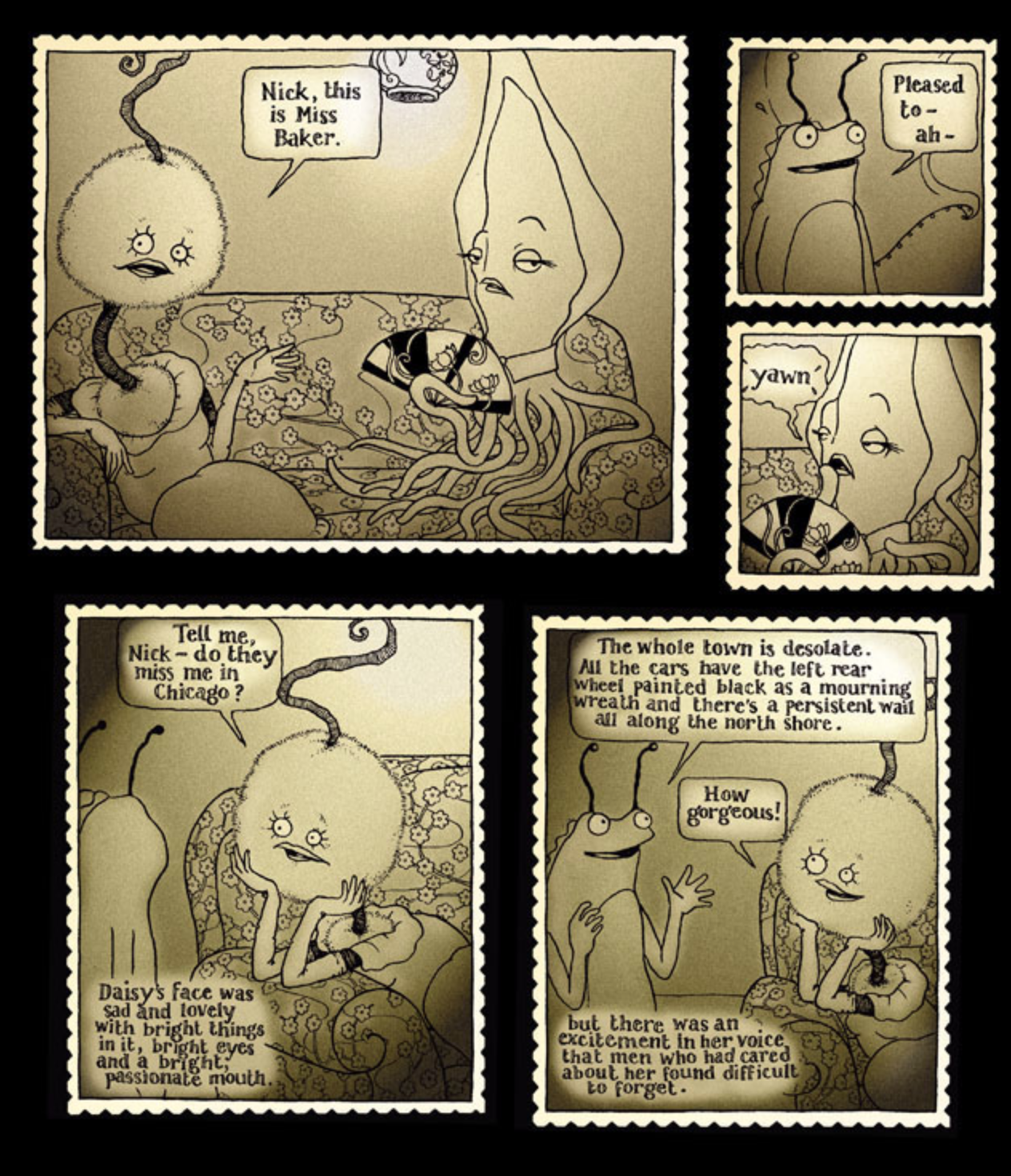
The Great Gatsby - graphic novel adaptation


So, you can do justice to a timeless classic in graphic novel form. Who knew? Nicki Greenberg's six-year labour of love is palpable in the richness of the illustrations and the selection of text. Wow, I say.

It has been many years since I discovered Gatsby. A romantic at heart, I loved it. I am sharing this post in the hope that some of you less literature-lovin' folk will dip a toe in and see what the fuss has been about.

To my mind, by cartoonifying the characters (is that even a word?), the reader can absorb enough of the original text without feeling giddy.

Check out the arrogance and disdain captured in the expression and body language of Miss Baker. Brilliant! Greenberg has managed to do this for all the characters, every time. What a gift!

Do yourself a fat favour and read the book.

Miss ^__^

Monday, 4 December 2023

In the Secret Place

 by Gary Crew (c) 2023


It has been a long time since I have read an engaging story which I would class as ‘gentle’ in its tone. ‘In the Secret Place’ has all the hallmarks of a good story without any of the angst and desperation of the hard-hitting issues of today which are so prevalent in YA Fiction In that regard, I think students from Year 5 – Year 8 (10 – 13 year olds) would appreciate this novel.

The story is about Ben Gardner, likeable and smart (he’s good at chess) yet carrying a painful secret which is somehow tied to his mildly crippled foot. Of course the bullies (called The Six, or, The Stupid Six!)) smell his fear and often torment him about his disability. Ben finds solace in his new friendship with Sonya (she doesn’t judge him) and the fact he has found a secret place down by the beach – a cave, which was only discovered by him because of a ‘disappearing’ fox.

              Yes, the fox had gone but, as he groped, pressing his fingertips against the chilly rock, all of a sudden, he fell forward.

              No cliff.

No rock.

He pulled back ono the track, lowering his backside onto the cushioning mac, crumpled there. His hand went to his mouth. The thought dawned: ‘There’s a hole behind there. A hole no one can see. The fox’s den, I bet…

In the deeper dark behind the bush, and with his torch battery useless, it wasn’t easy to access this secret place. (pp.73-4)

Crew has ensured that there are many plotlines that are all deliciously tied together by the final pages. The protagonist is ‘everyboy’ (as opposed to everyman) whose ‘coming of age’ embraces concerns ranging from the need to find your people, to self-worth, to the maybe flourishes of a first crush, to navigating a broken family, to the classic avoidance of the ‘mean boys’, to making your own adventure, to finding your inner strength, all of which are gender neutral, making the story ideal for all readers.

If I have one criticism, it would be that the protagonist’s dad drinks. Beer. Every time he is mentioned (it seems) and his lady companion is also usually chugging down wine when she isn't riding her Harley. The couple cannot 'do life' without downing a cold one. Crew does not comment on this, and it is certainly not key to any part of the plot – I am just on a bit of a bandwagon personally in a bid to stop the cultural acceptance of drinking. That aside, a do give this book a hearty recommendation. It is no wonder that Crew is heralded as ‘award-winning’.


Sunday, 13 March 2022

The Happiest Man on Earth


By Eddie Jaku ©2020


The cover reads: A Holocaust survivor shares how he found gratitude, kindness and hope in the darkest of places. This memoir can be read in one sitting. Jaku shares his memories of the hell that was the Holocaust in small snapshots. A good idea, really, as one long discourse of the inhumanity and terror would be too hard to bear.

Do I hate that man? No, I do not hate anyone. He was just weak and probably as scared as I was. He let his fear overtake his morals. And I know that for every cruel person in the world, there is a kind one… (p.105)

Suffice to say, this man is riddled with positivity. He survived on hope, living one day at a time, using intuition and taking calculated risks. He talks about broken bones and bullet wounds in the same way as I would tell you what I put on my toast this morning. Jaku has supreme faith in humanity – he doesn’t dwell on aberrations such as Hitler and the Nazis. At over 100 years old, we can learn much wisdom from this man. Check out his Ted Talk, much of which is in the book.

Saturday, 12 March 2022

Funky Town


By Paul (PK) Kennedy ©2021


Given I don’t have a sporting bone in my body, I applaud PK for his beautiful memoir which allows people like me to finally understand what the ruckus is all about. ‘Funky Town’ gets to the core of Aussie Rules by imbibing an intensely personal and, at times, vulnerable insight into how it feels to live and breathe footy. Kennedy dreamt of playing for the big league from childhood. His story reveals the highs and very lows without a sniff of the usual clichés. Sure, I skimmed over the cast of famous names and clubs, but the attention to detail in the writing had me mesmerized despite my ignorance. The fight for sporting fitness, the pre-match butterflies, the need to adhere to ‘superstitious’ rituals, the worship of brilliant players, the pithy and inspirational words measured out by the coach, the injuries, the timely reprimands… Most engaging, the rich descriptions of what it feels like to play at one’s peak:

The ball was finally mine. I ran my hands over it, turning it around and around. I looked down at its taut laces and little rubber valve. The familiarity of touch felt like an antidote to my self-doubt… The next twenty minutes surpassed all my previous feats in football, modest as they were to that point. Under a grey sky, with a breeze at my back, I forgot about my opponent and chased the ball, like a dog after a frisbee. Luck ran my way and I started to take marks, receive handballs, and even shout directions to other Saints. Most importantly, I stopped overthinking. The flow of the game, which had seemed hectic and foreign to me before, was now as familiar as kicking drop punts at the lightpost outside our house at Emmanuel Drive. I felt fresh and new and dynamic… With every possession my confidence surged. Words of encouragement from teammates were extra fuel. At one point I snatched up a loose ball in the back pocket and took off. My opponent came close to catching me. I heard him straining with effort. The boundary line was close, but I wasn’t about to surrender to it. I veered away, back into space. There were teammates on the wing, but they seemed miles away. Now I heard voices from the crowd. Carlton supporters. ‘Get him.’ ‘How far!?’ I hoped the Blues player chasing me wasn’t quick enough. I sidestepped one last time, swerving back toward the boundary. Without time to straighten up again, I guided the ball with my left hand onto my left foot. It wasn’t my natural side, but it felt natural now. I lowered it on an angle, the way you do when you want to kick a torpedo. This was almost arrogant. It’s hard enough to kick a torpedo on the run with your preferred foot. Luck winked at me. The ball landed in the perfect spot – to the side of my laces – and the ball covered the distance to my target at head height. I soaked up the clapping from Saints supporters. (excerpt from Chapter 28 ‘Another Chance’)

Believe it or not, the memoir is only in part about PK’s love of football. There is another important thread woven through his memories which spotlights the chilling truth of living in the same community as a serial killer. If you’re like me, you have the iPad handy to investigate further. (I had left Victoria by the time these murders occurred, so this was news to me.) No spoilers here. You’ll have to read the book to find out what ensued.

Another important inclusion outlines PK’s shyness and perceived awkward behavior around girls, and the culture of binge drinking to overcome this. His honesty here will be a huge encouragement and support to many teenagers.

I guess my final word on this would be how moving PK’s ‘functional’ family was/is. In this fatherless generation (such as were both his parents) it is rewarding to read about a stable, loving and imperfect family. This aspect of the text is very uplifting.

I recommend this text for older youth. Or PG recommended if being read by younger teens. A brilliant ‘coming of age’ read.

Wednesday, 7 July 2021

Where We Begin – The Past Is Waiting


©2020 Christie Nieman

This is a tidy and well-written story. It has been a while since I have read a YA novel that doesn’t have a driving narrative – until now. Put it this way, I had ten pages to go and I opted for crochet and Le Tour. If you are just looking to read a story and not be challenged, changed or enthralled, then this is the book for you.

The protagonist is 17-year-old Anna. She is a smart and driven student who aspires to become a doctor when she finishes school. Easy, right? Sure, if we overlook a few tiny factors including the fact that her mum is a high functioning alcoholic, her dad works overseas, and she has just discovered sex. Oh, and she becomes pregnant despite using contraception. I suggest this novel will be ‘triggering’ for anyone who can relate to some of the issues raised:

Why hadn’t I been able to take the pill? Why hadn’t I swallowed it? I would have been done. I could have been done with this. I could have been in control of my life again.

It wasn’t that I felt it was wrong in any way. I felt fine that this little clump of DNA was no more or less than the bacteria that covered every living thing, just as amazing and astounding and improbable, but also just as oblivious and expendable.

So it wasn’t a moral problem. It was just… something unexpected. (p.183)

Anna’s decision to leave home to sort herself out is made for her when her mother, Cathy, has a frightening drunken outburst which culminates in Cathy smashing a glass that inadvertently cuts Anna’s boyfriend. Anna boards the next bus bound for the country and the grandparents she has never met. It is here where most of the story unfolds as Anna discovers her mother’s past. The chapters which are set in Cathy’s time were, to my mind, the most intriguing. Have you ever wondered why your parents think and behave as they do? All the dots are joined as we meet Cathy’s bff, observe her controlling father, and wonder why the hell Anna was never told she had an uncle.

There are moments of drama when Anna decides to study in the creepy old abandoned farmhouse – Bromley Cairn – but these are not sustained. It also becomes increasingly frustrating when there’s no network coverage for Anna to reply to her oh so loyal and understanding boyfriend Nassim (who is none the wiser about the pregnancy):

I don’t understand what’s going on. I don’t want to crowd you, I know I’ve promised not to do that, but it’s super hard when you just totally disappear like this. You know that I can leave you alone as much as you want, so long as I know where I stand – I’ve said that right from the start. But right now I just don’t know where I am with you, and quite frankly it feels like shit… So feel free to take this as our break-up if you like. I don’t want to break up. I guess you know that. I still want to be with you… (pp. 201-3)

Whatever. I think I prefer more definition in a plotline.

That said, the writer provides some engagement via Basil, the son of her mum’s bff. He is more than happy to fill the gaps in Anna’s understanding with what he either knows or has heard. This takes a predictable turn when he enlightens her about the sordid past in terms of the bloody ousting of the land’s first inhabitants. We can never hear too much about this – just sayin’.

So I did eventually finish the novel. What happened to the baby, you ask? You tell me!

Miss ^__^


Saturday, 26 June 2021

When Rain Turns To Snow


© 2020 Jane Godwin

Hmmm. I was trying to work out why I did not particularly warm to this novel. In a nutshell, I’d say it’s because one of the driving conflicts centers around a neglected 5-month-old baby who is sporting both a temperature and a mystery cough. I think I was so fixated on the welfare of the baby that much of the ‘beautiful and timely coming of age’ story went out the window with the bath water! The good news is, the writer is not pitching the story to my 50-something age group. Huzzah!

Still, I can’t muster up enthusiasm for this book. It was too ‘soap opera’ for me. Not that I watch them, but if you enjoy ‘Home and Away’ or ‘Neighbours’, you’ll love this book. No loose ends. A tidy and overly dramatic story for 13-year-old girls. 

‘Hi. Did you get some sleep?’

‘I’m scared I’ll squash her if I fall asleep,’ he says, holding Mercy gently in his arms.

‘Let’s not wake her up,’  I whisper. The night is so still, so quiet, the sound would really travel.

But too late, she’s going to start crying again.

I give Reed the bottle. ‘It’s too hot for her,’ he says.

‘I didn’t know she’d be drinking it right away.’ He could have said thank you for getting it! No one appreciates what I’m doing for them. I go to the tap in the garden. Dark, icy water runs over my hands as I top up the bottle. I’m sure a bit of tap water won’t hurt her.

‘Feel her forehead,’ whispers Reed when I come back in.

My hand covers her whole forehead because she’s so tiny. ‘It’s hot.’                    (pp.132-3) 

See what I mean. And don’t get me started on the fact that the baby’s nappy hasn’t been changed in 24 hours! I realise I’ve said nothing about the characters or plot. You can join the dots. Knock yourself out. I’ll end on this from page 233 where the protagonist’s brother has been accused of cyber-bullying: 

In the picture, Harry’s hand is on Amber’s thigh. She’s wearing denim shorts. I remember that she’d been to Queensland and still had a tan.

‘I mean it’s just my personal opinion-‘ begins Sadie.

‘I am sick of your personal opinion!’ I shout without thinking. ‘She sat on his knee. So what! My brother’s got nothing to do with Rate Year Eight, so find out who it is and get them to take it down…Stop spreading rumours about my brother!’ I yell at them all.

‘Omigod,’ Poppy whispers, ‘what is wrong with you?’


Miss ^__^

Friday, 21 May 2021

When the Ground is Hard – Malla Nunn ©2019


I loved this book! The absorbing and satisfying story was reminiscent, to me, of the satisfying days of old after finishing an Enid Blyton ‘Famous Five’ story – in a good way. Yes Blyton’s writing is naïve and immensely politically incorrect, but that’s not what I’m referring to. Nunn’s story is tightly scripted such that every chapter leaves the reader with a sense of satisfaction akin to eating a delicious but well-proportioned dinner. But enough of my feelings and lame similes.

As outlined in its blurb, the author was born in Africa and came to Australia to ‘escape apartheid’. The best part of this harrowing fact is that Nunn’s writing immerses the reader in all the beauty, chaos and diversity of her home country. I can’t comment on how close to the truth her descriptions are, having never been, but I have seen my fair share of films which would attest to the plausibility of the book’s inclusions. What hasn’t Nunn included? This book has, to my mind, everything a young reader could hope for: true love, stolen undies, a natural disaster, racism, African culture, ‘mean girls’, child abuse (the teachers keep the students in line by hitting them with rulers and switches), danger, discovery, death – maybe?? adultery …Not gonna lie, I did get tears on page 229.

The best part? Watching the evolution of the protagonist, Adele, from pig-ignorant to adventurous, empathetic and green-stick wise. The mother/nanna in me would hope that every young woman could flourish in the same way in the same short amount of time. I appreciated the efforts made by Nunn to show that Adele takes time to think. She is present (to use the cliché) and when something provokes her she learns to challenge her preconceived ideas. She is oh so teachable. Sigh. Much, if not all of this learning is borne of her unexpected pairing with a poor room mate at the boarding school they attend. Initially Adele is mortified to be stuck with a peasant, Lottie, but it is not long before we note that Lottie’s character is gold. Methinks it is no coincidence that Lottie’s surname is Diamond!

Here’s an excerpt from earlier in the book when we are offered a rare glimpse into Lottie’s vulnerability:

The thing is, though, right now, sitting across from her, Lottie doesn’t look tough at all. She is deathly pale, fidgeting with her fingers and frowning. She knows what will happen later this morning, and it pains her. So she sits and builds her wall higher; she cements the bricks closer and digs the moat deeper. Being impenetrable takes work. It takes effort. And the wall that shields her from the cruelty of boarding school children is not a birthright given by fairies or God above. It is earned. Lottie builds her wall one stone at a time. Time and time again. (p. 97)

I chose that because it captures Adele’s growing metacognition. Most of Adele’s peers thrive on the weaknesses of others; Adele is learning to swim against that tide and it is immensely (here’s that word again) satisfying!!

Enjoy! I jolly well did.

Miss ^__^

Friday, 16 April 2021

Across The Risen Sea

 Bren MacDibble ©2020


In the first instance, I am glad I followed my own mantra: Don’t give up until you’ve read at least 50 pages. This is because it did take time to tune into the plot and the characters - longer than usual, methinks – and I am thankful not to have ditched this book prematurely. But that might be just me!

This novel is an entertaining adventure story for young readers, say 10 -14 years, set in future earth after some sort of Climate Event has caused the sea to rise drastically. Think ‘Water World’ meets ‘Snowpiercer’!! I had to get over the hurdle of reading the ‘evolved’ (or should I say, de-volved) English language to get into the flow of what turned out to be a rollicking good story. One word that featured in the protagonist’s future vocab was ‘prolly’ (probably) which annoyed me before said little girl stuck on me ‘like a tick’, which is another one of her ‘cute’ phrases. Neoma frequently says ‘coz’ and ‘aint’. This is a reminder that the children who have survived haven’t been educated in school. They are described as ‘dressed in rags and stinking like fish’ (p.196). What’s not to love?

Once you work out that there are several island communities, each having adopted unique customs and quirks, it is intriguing to see how they have managed to endure. The biggest daily activities involve scavenging and fishing, which is not surprising. I could literally see the whole story playing out as a fabulous movie akin to ‘Life of Pi’. Each chapter is only a page or two long, its title summing up the key event contained within. This is fabulous if you just want ‘snack’ read – it’s so easy to pick up where you left off.

The conflict involves – without giving anything away – an invasion, an electrocution, shark – croc – pirate attacks, abductions and maybe a death or two?!? There are also unexpected moments of humour to ensure the entertainment keeps on coming! Here’s an excerpt from a chapter called Trouble to whet your appetite:

There’s a small boat in the channel… On a fine day we'd stop and investigate, maybe take it back to its moorings if it's got a name on it we recognize. This one looks real familiar. And I can't think why until it spins a bit towards us and a golden sun on the prow reflects a flash of lightning.

‘Ma!’  I yell over the crashing waves. ‘It's the siblings’ boat from the Valley of the Sun!’

‘Din’t they tie it off proper?’ Jag asks.

‘Something's happened to them,’ I say. I know it, deep in my heart. I've known it since I went to Jacob's Reach.

 ‘I ain't stopping to tie it on, Neoma, no matter what's happened,’ Ma says. She's frowning over her shoulder but not at me, at that swirl of green and black chasing us down. ‘Storm’s almost on us.’

‘Sail close,’ I say, ‘I'll grapple it, and we’ll tow it in.’ This boat could have clues about why it's bashing around out here empty without a sibling to be seen.

‘You'll break the grapple rope before you get it up to the same speed we’re going,’ Ma says.

‘I’ll winch it out, so it don't!’ I say and nod at Jag to get ready to do that for me.

‘Okay, but likely we’ll have to cut the rope anyway if it slows us down.’

Ma sails close and I hand the end of the grappling rope to Jag to let out as needed, and wrap it round the winch. Last thing I want to be doing right now is handling rope. My hands is raw meat.

Then I lean way over the keel, holding on to a stanchion real tight, swing and drop the grapple hook gently, without too much sliding through my hand, into the boat and drag it forward to hook it onto the board across the top of the prow as we sail on by.

‘Okay!’ I yell to Jag. ‘Let the rope out so it turns and gets up to speed.’

I go to turn away but something pale twitches in the bottom of the siblings’ boat, and I wonder if a fish got slopped in there by a big wave, but the pale thing has a thick ribbed tail, and in a flash of lightning it becomes a hand, palm upwards! Someone's in there under the tarp!

I scrambled back to the deck. ‘Someone's in there!’ I yell.

Ma looks at me like I grew an extra head. ‘Don't lose that rope, Jaggy-boy!’ she yells, dropping the sail a little to slow Licorice so we don't lose our tow, then turns to Dizzy. ‘What kind of trouble are we hooked into right now?’ (pp.63-5)


Happy Reading!

Miss ^__^

Thursday, 1 April 2021

The Boy Who Steals Houses - The Girl Who Steals His Heart

 C. G. Drews (c) 2019

Having just finished this book, I feel like I've been in the ring with Mike Tyson. It is a page turner and it is not for the  faint-hearted. 

The story centers around a couple of teen brothers who have had a vile childhood - their mother abandoned them; their drunk and violent father abused them before unceremoniously dumping them at their heartless aunt's house. Everything is exacerbated by the fact that the older brother, Avery, is autistic and is cruelly bullied by his peers. His younger brother Sammy has adopted the role of his Chief Protector, which sounds quite noble until you read that Sammy does what he knows best and resorts to uncontrollable physical violence, leaving a wake of blood and broken bones in their track.

The boys soon find themselves homeless and on the run.

Each chapter is interspersed with chronological flashbacks to help the reader see beneath the iceberg and maintain a shred of empathy instead of repulsion.

In start contrast, Sammy eventually finds himself swept up in the life of a 'normal' chaotic family who know nothing of his past and allow him to fall in step with their daily routines. And in this family, who are currently grieving the loss of their mother (who died too young of cancer), Sammy bonds with Moxie and begins to wrestle with his demons in the process of finding love. One asks, would she care for him if she really knew what he was like?

Here's an excerpt from early on wherein the brothers are staging a fight so they can steal wallets from the concerned crowd:

    Avery shoves him.

    It comes so fast that Sam doesn't have time to brace himself. He takes a stumbling step backwards, falling against a passer-by in a tangle of limbs and hair flopping over his face.

    'I'm sorry!' he gasps as the person shoves him off with a startled grunt.

    Their handbag isn't quite zipped.

    Sam's hand is in and out before he stands up.

    Then Avery is in front of him, shoulders knotted, jabbing a finger into Sam's chest. Right in the bruise. Sam's wince is real.

    'You want to run that by me again?' Avery shouts...

    Knuckles collide with Sam's jaw.

    His neck snaps to the side.

    His teeth sink into his tongue.

    The boardwalk reaches up and Sam's face c o l l i d e s with a thwack on the floorboard. His vision fractures.

    Avery really really forgot to fake that punch.

    Hands are already on Sam's arms, grabbing him, asking if he's OK as he's roughly propelled into a sitting position. Blood dribbles down his chin. Someone gives a heartfelt gasp. (pp.97-8)

And there's plenty more fight scenes where that came from, which leads me to think that this novel will appeal to any teens from year 7 - 9. It is fast paced from the start and contains an emotionally charged and satisfying ending. I enjoyed it!

Miss ^__^


Saturday, 27 March 2021

FUTURE GIRL by Asphyxia

 (c) 2020

From the blurb: FUTURE GIRL is the art journal of a 16 year old Piper, a visual extravaganza of text, paint, collage and drawings, woven into a deeply engaging coming-of-age story set in near-future Melbourne, created by Deaf writer, artist and activist, Asphyxia.


As with all novels, it comes down to personal preference. I didn't like this book. The story was labored and repetitive. There were pivotal plot lines that were jarring and implausible, such as the so-called genius scientist mother losing her job in spite of being bff with the current prime minister (who pops into her squalid shack for a cuppa to discuss  evolving policies, two guards complete with cammo and weapons standing by the door). There were too many what I class as 'Willy Wonka Golden Ticket' moments - those coincidences that keep arising, one after the other, to set the scene for the next chapter. The protagonist, who is deaf, just happens to fall in love with a lad whose mother is deaf. What are the chances?

It's not all bad though. The concept of creating a novel with original artwork on every page kept me, at least, turning the pages. I also appreciated the author's efforts to evoke empathy in the reader in terms of what it would be like to be deaf. The detail here was astounding, right down to wearing hearing aids, learning sign and/or needing an interpreter. I found it amusing when Piper was fighting with her mum, as kids do, and simply whips out her hearing aids! Discussion over! I think there'd be times when that move would be a blessing.

Asphyxia presents a bleak look at the near future. Throughout the novel Piper is borderline starving to death. There are global food shortages and the synthetic food, invented by Piper's mum, has been shown to have damaging side  effects:


'DO YOU GET FOOD POISONING OFTEN?' I ask.

Marley laughs and holds up a single finger. Once! He mimes vomiting, then makes a dismissive gesture to show it wasn't that bad.

'I THINK THE GOVERNMENT SENDS JOURNALISTS TO HOSPITALS TO PUBLICISE EVERY SEVERE CASE.' It's a brain stretch to put together the individual letters of so many long words and make sense of what he's saying. 'THEY'RE TRYING TO GET US ALL HOOKED ON RECON.'

Once I've digested what he's said, I shoot back, 'I THOUGHT THEY WERE TRYING TO SAVE US FROM THE DANGERS OF UNBALANCED WILD FOOD.'

But even before I've finished spelling out the words, I'm thinking of everything mum told me. Maybe the news makes food poisoning seem more common than it really is, just to get Organicore more money. But what about recon's health benefits?

'MORE LIKE CONTROL US THROUGH FORCED RELIANCE ON BIG CORPORATIONS VIA MASS MEDICATION, LACK OF KITCHENS IN WELFARE PACKAGES, PROPAGANDA IN EDUCATION...'

'RECON CURED CANCER! FIXED THE OBESITY EPIDEMIC!'

Marley squints at me, head to the side. 'I NEVER FIGURED YOU FOR A RECON GIRL.'

(pp. 107-8)


Likely this novel will appeal to 12 - 14 year old girls who may well be enthralled to read about Piper's burgeoning love for Marley, and, that elusive First Kiss.

Happy reading and viewing!

Miss ^_^


Monday, 8 March 2021

Catch Me If I Fall


Barry Jonsberg 2020

The story begins innocently enough with a gentle look into the family life of the 12-year-old protagonist twins, until Jonsberg drops a few sinister clues which foreshadow that all is not as it seems… something outrageous has happened to the climate, for starters. (This is not such a surprising theme given that 'climate change’ is currently a huge and controversial issue.)

As the blurb relates, one of the twins undergoes a personality change of sorts after a near fatal accident. Watching the transformation in the twins’ relationship, post-accident, is captivating – hence the title. Will their relationship survive? Throw in a super intelligent mother and a compliant father in addition to the twins, and the reader is craving to see what unfolds.

But by the time the twins meet a cluster of gypsy-like Mad-Maxian kids in the local park, and receive an ‘AI’ puppy for their birthday, you find yourself unexpectedly immersed in pure sci-fi!

              It had only taken the dog a day to learn the sound of his name… I thought that was brilliant and just the way a real dog would behave…

              ‘How does he get his power?’ asked Charlotte.

              ‘You see his fur? Each strand is a tiny fibre optic cable. All together they act like about a zillion solar panels.’ (pp.104-5)

The story’s intensity increases as it develops, throwing the reader into an almost philosophical head space where one can speculate about both surviving an apocalypse and the place of Artificial Intelligence. Yes, these themes have been done before but Jonsberg masterfully revisits each by imbibing a fresh take on them for teen readers.

I feel the ending of the novel lends itself to a sequel! I’d recommend this novel to readers aged 10 – 14. It is a satisfying sci-fi read with enough twists to keep you turning the pages.


Thursday, 4 July 2019

The Name of the Wind

Patrick Rothfuss (2007)


I’m not a huge fan of the fantasy genre but there are one or two classics that are right up there including the Narnia Chronicles and Lord of the Rings. So when I was invited to read this door stopper I was a bit hesitant. Did I really want to commit to several ‘fantasy hours’ with an unknown writer? The shining eyes of its recommender (cheers, Jay) pushed me over the line enough for me to sagely commit to at least the first 50 pages. This is what I say to my students, too. Give it 50 pages before giving up on it. Well, within the first 10 pages I was hooked! (The first 10pp of the story, that is - I almost didn’t get there on account of the fact that this particular book is a commemorative limited edition hardback with a long winded self-aggrandizing author’s note. That was vile. Do not, I repeat, DO NOT read that part of the book if you happen across this 2017 edition. Unless you want to look at your favorite Hollywood actor with no make-up, in track pants, on the loo.)

‘The Name of the Wind’ is a rollicking good tale! Hugely entertaining!! The protagonist is perfect for this genre. So named ‘Kvothe’ is highly likeable. He is off-the-charts smart but due to his age (15-ish) is naïve and vulnerable as he is making his own way in the world. Of course, he has magic powers, but these are largely unexplored and under-developed which can create mayhem on days.

The author has ensured that all the fantasy boxes are ticked without being tedious or predictable. Every ‘instalment’ has a cliff-hanger, page-turning ending, which can be a problem if you want to eat, sleep, shop or shower! Several times I found myself exclaiming aloud or even talking to the book. That’s right up there with idiots who yell answers at the TV when watching quiz shows. Don’t they know the contestants can’t hear them?

Another reason I loved this story is the sporadic use of mischief and straight-up humour. Life is too short to be miserable – anything that can bring a smile or evoke a LOL is worth the investment. Rothfuss puts his capable finger on the pulse of the human condition at every turn. He is, quite plainly, a solid writer of merit. I say, get on board! I am gagging to read the sequel which is right next to me on Jay’s kindle. Yee har!!

            I was a curious child: quick with questions and eager to learn. With acrobats and actors as my teachers, it is little wonder that I never grew to dread lessons as most children do.
                  The roads were safer in those days, but cautious folk would still travel with our troupe for safety’s sake. They supplemented my education. I learned an eclectic smattering of Commonwealth law from a travelling barrister too drunk or too pompous to realise he was lecturing an eight-year-old. I learned woodcraft from a huntsman named Laclith who travelled with us for nearly a whole season.
                  I learned the sordid inner workings of the royal court in Modeg from a… courtesan. As my father used to say: ‘Call a jack a jack. Call a spade a spade. But always call a whore a lady. Their lives are hard enough, and it never hurts to be polite’.
                  Hetera smelled vaguely of cinnamon, and at nine years old I found her fascinating without exactly knowing why. She taught me I should never do anything in private that I didn’t want talked about in public, and cautioned me to not talk in my sleep.
                  And then there was Abenthy, my first real teacher. He taught me more than all the others set end to end. If not for him, I would never have become the man I am today.
                  I ask that you not hold it against him. He meant well. (p.55)

Wednesday, 13 February 2019

Year of Wonders – Geraldine Brooks

Have you ever wondered what it would have been like to live in the Middle Ages during the time of the Black Death? I was introduced to this book over ten years ago when I taught it to my year 10s. I loved it so much that when I was in the UK a few months ago I made sure I visited the actual village – Eyam – where the story was set. Talk about 3D writing! What a privilege to see everything come to life as I walked the very paths mentioned in Brooks’ fine work.

Brooks outlines in the afterword how she stumbled across the village of Eyam whilst on assignment in London in 1990. I, too, was captivated by its history, namely, in how the minister of the time passionately implored the residents to ‘lock down’ the village in a bid to stop the ‘plague seeds’ spreading beyond and infecting the nearby locales.

Beloved, I hear you in your hearts, saying that we already have fear. We fear this disease and the death it brings. But you will not leave this fear behind you. It will travel with you wheresoever you fly. And on your way, it will gather to itself a host of greater fears. For if you sicken in a stranger’s house, they may turn you out, they may lock you up to die in dreadful solitude. You will thirst, and none shall quench you. You will cry out, and your cries will fade into empty air. For in that stranger’s house, all you will receive is blame… they will heap their hatred upon you, in the hour when your greatest need is love! (Rev. Mompellion pp.105-6)

This work of fiction is plausible. There are storylines which adhere closely to historical records. I can testify to viewing the actual ‘plague houses’, the church, and many inscribed tombs. As for the rest, Brooks envelops the reader in the likely superstition, the livelihoods, the class structures, the religion and the very language of the period. The detail is graphic; the relationship dynamics are timeless.

            I almost dropped the pitcher in my shock… George Viccars lay with his head pushed to the side by a lump the size of a newborn piglet, a great, shiny, yellow-purple knob of pulsing flesh. His face, half turned away from me because of the excrescence, was flushed scarlet, or rather, blotched, with shapes like rings of rose petals blooming under his skin. His blonde hair was a dark, wet mess upon his head, and his pillow was drenched with sweat. There was a sweet, pungent smell in the garret. A smell like rotting apples. (p.42)

Brooks is a brilliant writer. My attempts to capture her gift in weaving a story leave much to be desired! She always manages to capture the tension wrought in the human condition – to save others at the peril of losing your own life or not. And of course there’s the sexual tension: sometimes restrained; sometimes unbridled. Just enough. Never gratuitous.

Enjoy my Eyam pics. What a ride!
Entrance to Church, Eyam Village UK


The original 'plague houses' still standing.


Courtesy of the Eyam Museum - replicas of George Viccars (the tailor) and Anne Frith

Replica of plague attire - the 'beak' is full of herbs

Replica of Rev. Mompesson (Mompellion) meeting with Rev. Stanley

Replica of the boundary stone. The holes were filled with vinegar before coins were added in exchange for supplies from beyond the village.

Plague victim. 

Catherine Mompession's tomb. 1666


I reckon this is the ancient celtic cross Anna Frith clung to in her time of despair.